
Main Courses
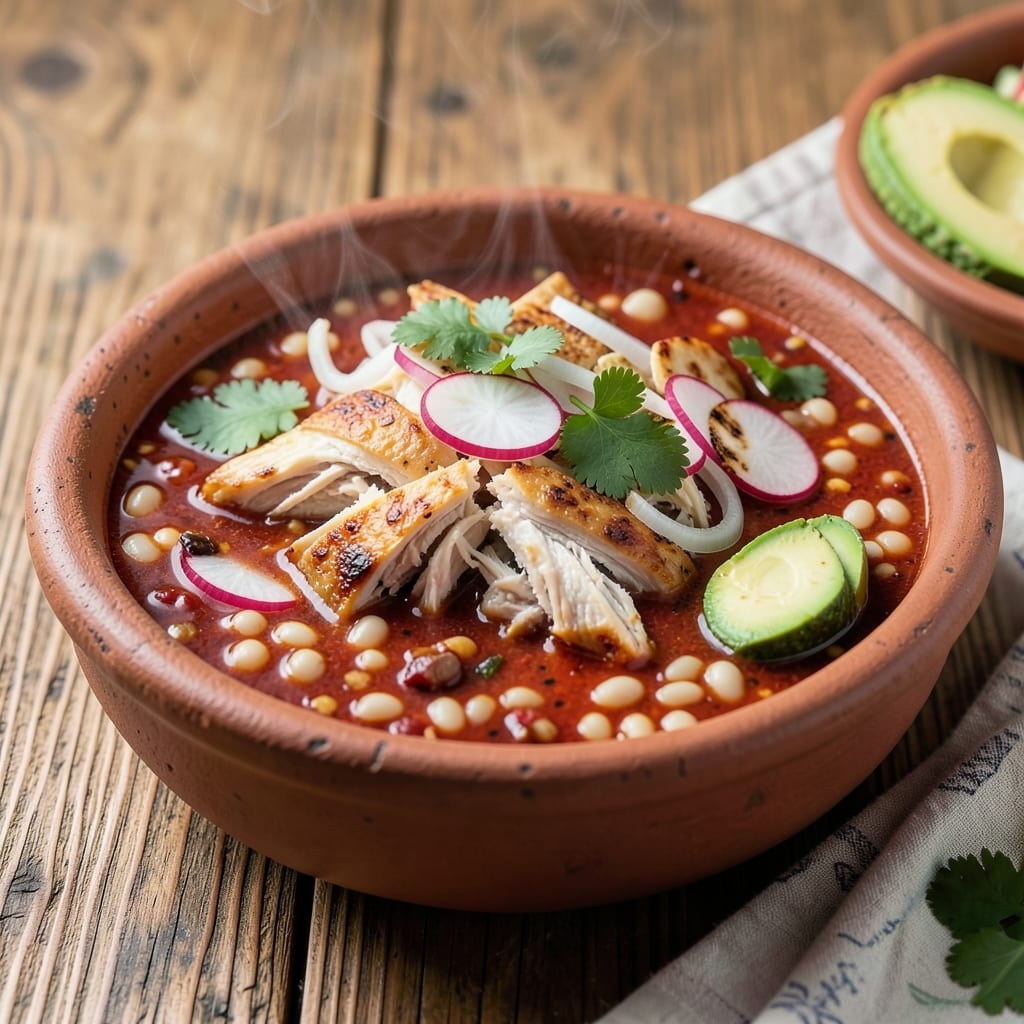
This authentic Mexican red chicken pozole recipe delivers the soul-warming flavors of Mexico's most beloved comfort dish—rich, smoky, and layered with tradition. The secret lies in slow-simmered broth infused with dried chiles, hominy, and aromatic spices that deepen with every sip. I've perfected this version after years of testing, balancing authentic techniques with home-cook practicality for a dish that feels both rustic and refined.
The foundation begins with properly toasting and rehydrating dried chiles (guajillo and chile de árbol) to create a complex, slightly sweet-spicy base. Chicken thighs and drumsticks break down beautifully during the 3-4 hour simmer, while hominy (granos) soaks up the smoky essence of the broth. Fresh epazote, a signature herb, adds a bright, anise-like finish that cuts through the richness.
What you'll end up with is a steaming bowl of pozole that's vibrant red, fragrant, and packed with tender chicken, hearty hominy, and a broth so flavorful it deserves to be served in a communal pot. The dish comes together with minimal prep but maximum flavor, making it perfect for gatherings or cozy weeknight dinners when you crave something truly special.
Serve with traditional toppings like radishes, lime wedges, and avocado slices for that authentic touch. This recipe stays true to Mexican tradition while offering flexibility for modern adaptations—like using a slow cooker for hands-off preparation. Let's create pozole that tastes like home.
Ingredients for authentic mexican red chicken pozole
The essential ingredients for pozole that tastes like Mexico's soulful tradition—dried chiles, hominy, and aromatic spices.
| Ingredient | Amount | Notes |
|---|---|---|
| Chicken Thighs and Drumsticks 🍗 | 3 lb | Bone-in, skin-on preferred |
| Dried Guajillo Chiles 🌶️ | 6 whole | Stems and seeds removed |
| Dried Chile de Árbol Chiles 🌶️ | 4 whole | Stems and seeds removed |
| Hominy (Grano) 🌽 | 2 cups | Canned, drained and rinsed |
| White Onions 🧅 | 2 whole | Quartered, skin on |
| Garlic Cloves 🧄 | 8 cloves | Peeled, slightly crushed |
| Fresh Epazote 🌿 | ½ cup | Chopped, stems removed |
| Fresh Oregano 🌿 | ¼ cup | Chopped, Mexican oregano preferred |
| Bay Leaves 🌿 | 2 whole | Dried, crumbled |
| Cumin Seeds 🌿 | 1 tbsp | Toasted lightly in dry pan |
| Salt 🧂 | 2 tsp | Kosher or sea salt |
| Black Peppercorns 🌶️ | 1 tsp | Freshly cracked |
| Cinnamon Stick 🌿 | 1 whole | Optional, for depth |
| Chicken Broth 💧 | 6 cups | Homemade or low-sodium store-bought |
| Lime Juice 🍋 | ¼ cup | Freshly squeezed, reserved |
The dried chiles are non-negotiable for authentic flavor. Mexican specialty stores or the Latin aisle at Whole Foods carry guajillo and chile de árbol—look for vibrant color and no signs of mold. Toast them lightly in a dry skillet to deepen their smoky notes before soaking in hot water. For the hominy, Goya or La Costeña brands are reliable, but any canned hominy works. The chicken thighs and drumsticks should have good marbling for juiciness—Costco or local butchers often have excellent cuts. Fresh epazote can be tricky to find outside Mexican markets, but if you can't locate it, cilantro or Mexican tarragon adds a similar brightness.
No guajillo chiles? Ancho chiles at half the amount work in a pinch, though they'll be slightly sweeter. Substituting canned chipotle in adobo adds heat but lacks the complexity of dried chiles. For the hominy, if you can't find it, white beans or corn kernels add texture, though they won't replicate the traditional taste. The chicken broth can be swapped for water if needed, but homemade or low-sodium store-bought ensures better flavor. If you're short on fresh epazote, dried epazote at one-third the amount or even a pinch of anise seeds can mimic its flavor profile. The cinnamon stick is optional but adds warmth—skip it if you prefer a cleaner taste.
Toasted chiles and cumin seeds can be prepped a day ahead and stored in an airtight container for up to 1 week. The hominy keeps well in its canned liquid for 3 months in the pantry, while fresh epazote should be used within 3-4 days of purchase. The finished pozole reheats beautifully—simmer gently for 10-15 minutes to meld flavors. For leftovers, store in the fridge for 4-5 days or freeze for 3 months. The broth actually improves overnight, so plan to make extra for second servings.
Why You'll Love This Recipe
- One-Pot Magic: I swear by this recipe because it’s actually one-pot—no chopping up onions into tiny bits or fussing with multiple pans. Just sear the chicken, toss in the dried chiles (already rehydrated in hot water), and let the hominy do its thing while you stir in the onions at the end. That’s it.
- Smoky Depth Fast: Between the guajillo and árbol chiles, this broth has layers—earthy, slightly sweet, with a kick that lingers. I’ll be real: the first time I tasted it, I thought, “Wait, this is way better than takeout.” And it’s all from soaking those dried peppers overnight (or even just 20 minutes if you’re in a rush).
- Weeknight Crowd-Pleaser: Honestly, this is my go-to for game days, lazy Sundays, or when my partner’s friends drop by unannounced. The hominy gives it that satisfying chew, the chicken falls off the bone, and everyone—even the picky eaters—ends up asking for seconds. (Yes, even on a Tuesday night.)
- Budget Feast Leftovers: Chicken thighs and drumsticks stretch forever, and hominy is cheaper than rice. Make a big batch, and you’ll have hearty lunches for days—just reheat with a splash of water and a sprinkle of lime. My college budget would’ve wept with gratitude.
Step-by-step instructions for authentic Mexican red chicken pozole
Here's the traditional method that delivers rich, complex flavors and a broth that deepens with every sip.
Toast and Prepare the Dried Chiles
Begin by toasting the 6 whole dried guajillo chiles and 4 whole dried chile de árbol chiles in a dry skillet over medium heat for 1-2 minutes per side until fragrant and slightly puffed. This step enhances their natural flavors and removes any potential bitterness. Transfer the toasted chiles to a bowl and cover with 6 cups hot chicken broth to soften.
While the chiles soak, toast the 1 tablespoon cumin seeds in the same skillet for 30 seconds until aromatic. This toasting step is crucial—it deepens the earthy flavor profile of the pozole. Remove the cumin seeds from heat immediately to prevent burning, then set aside with the soaked chiles.
Build the Flavor Base with Aromatics
In a large pot, combine the soaked chiles with their soaking liquid, the toasted cumin seeds, 2 whole quartered white onions (skin on), 8 peeled garlic cloves, 2 whole crumbled bay leaves, and the 1 whole cinnamon stick. Bring to a boil over high heat, then immediately reduce to a simmer and cook uncovered for 20 minutes. This initial simmering process extracts maximum flavor from the chiles and aromatics.
After 20 minutes, remove the onion skins, garlic cloves, and cinnamon stick. Discard the onion skins and garlic cloves, but keep the cinnamon stick in the broth if using. The broth should now have a deep red hue and a rich, peppery aroma. This is the foundation of your pozole's complex flavor.
Simmer the Chicken and Hominy
Add the 3 lb chicken thighs and drumsticks to the simmering broth. Return to a gentle boil, then reduce heat to medium-low and simmer uncovered for 1 hour. The chicken should cook just until the meat is tender but not falling off the bone—it will finish cooking later. Skim any foam that rises to the surface during the first 15 minutes of cooking.
After 1 hour, remove the chicken pieces with tongs and let them cool slightly before shredding or deboning. Strain the broth through a fine-mesh sieve into a clean pot, pressing gently on the solids to extract maximum flavor. Return the strained broth to the pot and bring to a simmer. Add the 2 cups hominy (grano), 0.5 cup chopped fresh epazote, and 0.25 cup chopped fresh oregano. Simmer gently for 15 minutes to allow the hominy to rehydrate fully and the herbs to infuse.
Season and Finish the Pozole
Return the shredded chicken to the pot along with the broth and hominy. Add the 2 teaspoons salt and 1 teaspoon freshly cracked black peppercorns. Taste the pozole and adjust the seasoning—you may need to add more salt or a splash of 0.25 cup lime juice to balance the flavors. The pozole should be rich, slightly tangy, and deeply aromatic.
Keep the pozole simmering gently on low heat until ready to serve. The broth will continue to deepen in flavor as it sits. For the most authentic presentation, serve the pozole in individual bowls with shredded lettuce, sliced radishes, avocado, and lime wedges on the side. The contrast of fresh toppings with the rich, spiced broth is what makes this dish truly special.
Pro Tips For Making Authentic Mexican Red Chicken Pozole
- BLANCH THE CHILES FIRST: I learned this the hard way—dry-roasting guajillo and árbol chiles straight from the package always leaves bitter flecks in your broth. Soak them in hot (not boiling) water for 10 minutes first, then drain and roast. The skins slip right off after that, and your pozole won’t taste like you’re eating chile dust.
- SIMMER HOMINY UNTIL IT’S SOFT: Skip the "just rinse and toss" approach—hominy needs to cook for at least 20 minutes in the broth to soften properly. The difference between mushy and al dente hominy is that extra time simmering with the onions and garlic. (Yes, even if you’re impatient like me.)
- DON’T SKIP THE ONION CARAMEL: Low and slow is the only way to get that deep, sweet base for your pozole. Cook the white onions in their own rendered fat (or oil) for 20-25 minutes until they’re golden brown and jammy. This isn’t the prettiest method, but it’s the thing that makes your broth taste like it came from a street cart in Oaxaca.
- USE DRUMSTICKS FOR CRISP SKIN: Thighs and drumsticks work best when you brown them skin-side down first—don’t skip this. The crispy skin adds texture and flavor that can’t be replicated any other way. If you’re short on time, par-cook the chicken in a 375°F oven for 15 minutes before searing, but still brown it hard. (Your future self will thank you.)
Pro cooking tips for great authentic mexican red chicken pozole
Chile Toasting Mastery
Toast your guajillo and chile de árbol chiles just until they release their aroma—1-2 minutes per side over medium heat. Watch closely to avoid burning, which turns them bitter. I like to hold them with tongs and rotate frequently. Once toasted, soak them in 6 cups hot chicken broth for 15 minutes to soften completely. This step is non-negotiable for authentic flavor—skipping it results in a flat-tasting broth. 🌶️
Simmering Secrets
Simmer your pozole uncovered at medium-low heat—never a rolling boil—to preserve the delicate flavors. After 1 hour of cooking the chicken, strain the broth through a fine-mesh sieve to remove solids, pressing gently to extract every last drop of flavor. This step creates a silky, restaurant-quality texture. I use a Reusable Fine Mesh Strainer from Amazon for this purpose.
Hominy Hydration
Add hominy to the broth only after it's fully strained and simmered with herbs for 15 minutes. This ensures the hominy absorbs the rich, spiced broth rather than watering it down. If using canned hominy, drain and rinse it thoroughly to remove excess sodium. For extra tenderness, I like to add hominy 10 minutes before serving to prevent overcooking. 🌽
Epazote Essentials
Fresh epazote is the secret ingredient that elevates pozole from good to extraordinary. Use 0.5 cup chopped fresh epazote and add it only in the final 15 minutes of simmering to preserve its bright, anise-like flavor. If you can't find fresh epazote, substitute with 1 tbsp dried epazote or 1 tsp anise seeds. Never skip this herb—it's what makes pozole uniquely Mexican. 🌿
Slow Cooker Adaptation
For a hands-off approach, transfer all ingredients to a 6-quart slow cooker and cook on low for 6-8 hours or high for 3-4 hours. The slow cooking enhances the broth's depth naturally. I recommend using a Breville slow cooker for even heat distribution.
Broth Depth Boosters
To intensify the broth's flavor, add a 1-inch cinnamon stick and 2 bay leaves during the initial simmer. These aromatic ingredients infuse subtle warmth without overpowering. For extra richness, I sometimes add 1 cup extra chicken broth after straining to compensate for any liquid lost during cooking. The result? A broth so flavorful it deserves to be served in a communal pot. 💫
Nutrition facts
Frequently asked questions
Why does authentic pozole need both guajillo and chile de árbol chiles?
Guajillo chiles provide a fruity, slightly sweet base while chile de árbol adds a bright, peppery heat. Together they create the signature complex flavor profile that separates authentic red pozole from other Mexican dishes. The combination balances sweetness, smokiness, and spice perfectly.
Can I make pozole in a slow cooker and still get authentic flavor?
The slow cooker method actually enhances the broth's depth. Use low heat for 6-8 hours to let the flavors meld naturally. The key is to toast the chiles and aromatics first—this step can't be skipped. The slow cooking process mimics traditional simmering while being hands-off.
What's the best way to store leftover pozole?
Store in an airtight container in the fridge for 4-5 days or freeze for 3 months. The broth actually improves overnight, so reheat gently on low heat for 10-15 minutes to restore its rich texture. Never microwave directly from frozen—thaw in the fridge first.
How do I adjust the spice level if I have sensitive stomachs at my gathering?
Start by reducing the number of chile de árbol chiles by half. For milder heat, remove some of the soaked chiles before blending. Always taste the broth before adding chicken—you can add 1 cup extra chicken broth to dilute the spice if needed. Lime juice helps balance heat too.
What's the difference between pozole rojo and pozole verde?
Red pozole uses dried chiles like guajillo and chile de árbol for its signature deep red color and complex flavor. Green pozole uses tomatillos and green chiles for a tangy, herbaceous taste. The broth base is fundamentally different—red is spiced and rich while green is brighter and more acidic.